
Optimum relative humidity for healthy skin
Why roughly 60% relative humidity supports stratum corneum hydration, and why ordinary moisturizers and humidifiers matter as humidity drops.
The outer layer of skin (i.e., stratum corneum or SC ) exhibits both biochemical and biophysical changes in response to variations in indoor temperature and relative humidity (RH). Researchers have found that a relative humidity of approximately 60% supports the healthy functioning of skin.
For example, early work by Blank (1952) revealed that as RH approached 60%, skin became "soft and pliable'. More recent research conducted by Vyumvuhore et al. (2013) using non-invasive Raman spectroscopy has shown that both the organization of lipids and protein structure in the SC is optimized at a RH of approximately 60%.
Based on these studies the optimum or target hydration level (i.e., water content) of untreated stratum corneum is 0.10 g water/mL SC (equivalent to about 8 wt% water content)
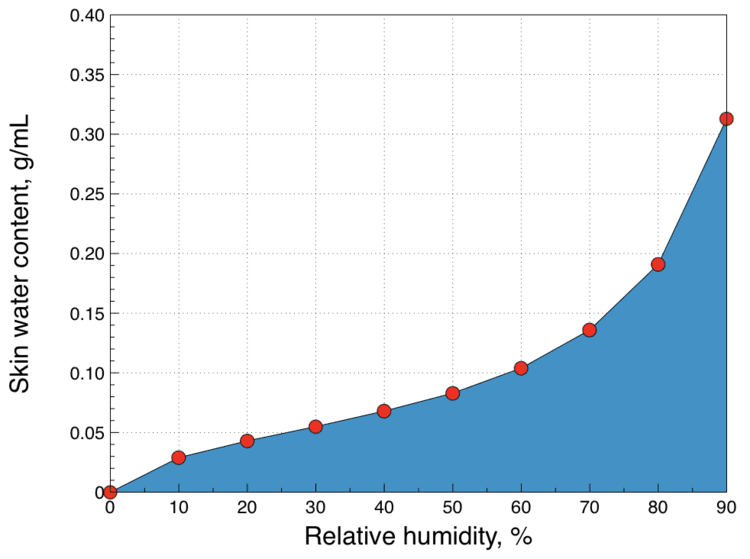
The water content of the stratum corneum changes with ambient relative humidity. The hydration level of skin also alters its biophysical and biochemical properties. At a target relative humidity of 60% skin is soft and pliable.
As indoor humidities decrease below 60% RH , the associated drying stresses produce stiffer skin and can also lead to the formation of dry, flaky skin as well as dandruff.
The primary skin-care options in indoor environments with sub 60% relative humidities consist of
the application of moisturizing lotions, creams, and shampoos as well as
the operation of a room humidifier.
Most moisturizers produce a thin film of an occlusive substance that inhibits or resists the diffusion of water through the skin into ambient air--thus compensating for reduced ambient humidity. In contrast, a humidifier simply adds water vapor to indoor air, which directly re-hydrates skin.
Note that an indoor relative humidity of 60% should be considered an upper-bound humidity goal because beyond this level the risk of indoor mold formation increases and air becomes less comfortable.
References
1. Blank, I. H. Factors Which Influence the Water Content of the Stratum Corneum. J. Invest. Dermatol. 18, 433–440 (1952).
2. Vyumvuhore, R. et al. Effects of atmospheric relative humidity on Stratum Corneum structure at the molecular level: ex vivo Raman spectroscopy analysis. Analyst 138, 4103–4111 (2013).
Dermidia Guide Lite
Turn this science into weekly guidance
Dermidia Guide Lite turns this science into a saved dashboard, seven-day outlook, compact 52-week context review, and weekly care cue for your area. Sign in by secure email link — no password or credit card.
Your email is used for Dermidia Guide Lite and is not shared with 3rd parties.